 Quote
Quote
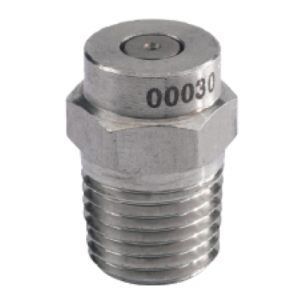
1/4″ Water Nozzles 00 Degree

Login to view price ..
0 Degrees
Characterized by a small opening, this nozzle emits a straight jet of water instead of a fan. It’s highly potent and ideal for challenging tasks.
However, it’s essential to note that the spray area is limited, making it time-consuming for larger jobs. It’s best reserved for use on robust materials like metal or strong concrete to avoid damage to other surfaces.
The 0-degree nozzle poses a risk of damaging wood, plastic siding or fences, and painted surfaces. Avoid using this nozzle on cars or vehicles to prevent potential harm.
Of all the components on a high-pressure washer, the nozzle is probably the most overlooked — and the most misunderstood. Many operators assume that pressure is determined by the pump. In reality, it is the nozzle that sets the working pressure of the machine. Get the size wrong and you will either lose cleaning performance or put unnecessary strain on the pump and unloader. This guide explains how to read the nozzle chart, how to select the correct size, and when to replace it.
What Does a Nozzle Actually Do?
The nozzle is the last point of restriction in the water circuit. Water travels from the pump, through the high-pressure hose, through the gun and lance, and finally exits through the nozzle orifice. The diameter of that orifice — combined with the pump’s flow rate — is what creates the back-pressure that we measure in bar. A smaller orifice creates more restriction and higher pressure. A larger orifice reduces restriction and drops pressure. This is why fitting the wrong nozzle has real consequences for machine performance.
What Happens if the Nozzle is the Wrong Size?
| Nozzle Too Small The pump generates pressure beyond what it was set for. Excess water is forced through the unloader bypass continuously, causing the unloader valve to overheat and wear prematurely. In severe cases this leads to unloader failure, seal damage, and pump overheating. The operator may also try to compensate by adjusting the pressure up — compounding the problem. |
Nozzle Too Large The orifice does not create enough restriction, so the machine cannot build to its rated pressure. Cleaning performance drops noticeably — more time on each surface, more passes required, and some applications become ineffective. The machine runs but underperforms, which often gets misdiagnosed as a pump problem. |
How to Read the Nozzle Chart
The chart below cross-references your machine’s working pressure in bar (columns) against flow rate in litres per minute (rows) to give you the correct nozzle size. Here is how to use it:
- Find your machine’s rated pressure in bar across the top of the chart.
- Convert your flow rate from l/h to l/min by dividing by 60. For example, 900 l/h ÷ 60 = 15 l/min.
- Find the value in the chart closest to your l/min figure in that pressure column.
- Read the nozzle size from the left-hand column on that row.
- Select one size smaller than what the chart shows — this compensates for orifice wear over time and keeps your machine at rated pressure for longer.
Machine: PWBC2015 — 200 bar / 900 l/h (15 l/min). Find the 200 bar column. Look for the value closest to 15.0 l/min. The chart shows nozzle size 045 at 14.5 l/min @ 200 bar. Select 045 or go one size down to 04 for added longevity.
Nozzle Selection Chart — Flow Rate in l/min
Columns = working pressure (bar) | Rows = nozzle size | Values = flow rate in l/min
| Nozzle | Ø mm | 20 | 40 | 60 | 80 | 100 | 120 | 140 | 160 | 180 | 200 | 220 | 240 | 260 | 280 | 300 | 320 | 340 | 360 | 380 | 400 | 500 |
|---|---|---|---|---|---|---|---|---|---|---|---|---|---|---|---|---|---|---|---|---|---|---|
| bar → | Flow rate in litres per minute (l/min) | |||||||||||||||||||||
| 015 | 0.80 | 1.5 | 2.2 | 2.6 | 3.1 | 3.4 | 3.7 | 4.0 | 4.3 | 4.6 | 4.8 | 5.1 | 5.3 | 5.5 | 5.7 | 5.9 | 6.1 | 6.3 | 6.5 | 6.7 | 6.8 | 7.6 |
| 02 | 0.91 | 2.0 | 2.9 | 3.5 | 4.1 | 4.6 | 5.0 | 5.4 | 5.8 | 6.1 | 6.4 | 6.8 | 7.1 | 7.4 | 7.6 | 7.9 | 8.2 | 8.4 | 8.7 | 8.9 | 9.1 | 10.2 |
| 025 | 1.00 | 2.5 | 3.6 | 4.4 | 5.1 | 5.7 | 6.2 | 6.7 | 7.2 | 7.6 | 8.1 | 8.5 | 8.8 | 9.2 | 9.5 | 9.9 | 10.2 | 10.5 | 10.8 | 11.1 | 11.4 | 12.7 |
| 03 | 1.09 | 3.1 | 4.3 | 5.3 | 6.1 | 6.8 | 7.5 | 8.1 | 8.7 | 9.2 | 9.7 | 10.1 | 10.6 | 11.0 | 11.4 | 11.8 | 12.2 | 12.6 | 13.0 | 13.3 | 13.7 | 15.3 |
| 035 | 1.15 | 3.6 | 5.0 | 6.2 | 7.1 | 8.0 | 8.7 | 9.4 | 10.1 | 10.7 | 11.3 | 11.8 | 12.4 | 12.9 | 13.4 | 13.8 | 14.3 | 14.7 | 15.1 | 15.6 | 16.0 | 17.8 |
| 04 | 1.19 | 4.1 | 5.8 | 7.1 | 8.2 | 9.1 | 10.0 | 10.8 | 11.5 | 12.2 | 12.9 | 13.5 | 14.1 | 14.7 | 15.3 | 15.8 | 16.3 | 16.8 | 17.3 | 17.8 | 18.2 | 20.4 |
| 045 | 1.27 | 4.6 | 6.5 | 7.9 | 9.2 | 10.3 | 11.2 | 12.1 | 13.0 | 13.8 | 14.5 | 15.2 | 15.9 | 16.5 | 17.2 | 17.8 | 18.4 | 18.9 | 19.5 | 20.0 | 20.5 | 22.9 |
| 05 | 1.35 | 5.1 | 7.2 | 8.8 | 10.2 | 11.4 | 12.5 | 13.5 | 14.4 | 15.3 | 16.1 | 16.9 | 17.7 | 18.4 | 19.1 | 19.7 | 20.4 | 21.0 | 21.6 | 22.2 | 22.8 | 25.5 |
| 055 | 1.40 | 5.6 | 7.9 | 9.7 | 11.2 | 12.5 | 13.7 | 14.8 | 15.9 | 16.8 | 17.7 | 18.6 | 19.4 | 20.2 | 21.0 | 21.7 | 22.4 | 23.1 | 23.8 | 24.4 | 25.1 | 28.0 |
| 06 | 1.47 | 6.1 | 8.7 | 10.6 | 12.2 | 13.7 | 15.0 | 16.2 | 17.3 | 18.4 | 19.3 | 20.3 | 21.2 | 22.1 | 22.9 | 23.7 | 24.5 | 25.2 | 26.0 | 26.7 | 27.4 | 30.6 |
| 065 | 1.52 | 6.6 | 9.4 | 11.5 | 13.3 | 14.8 | 16.2 | 17.5 | 18.7 | 19.9 | 21.0 | 22.0 | 23.0 | 23.9 | 24.8 | 25.7 | 26.5 | 27.3 | 28.1 | 28.9 | 29.6 | 33.1 |
| 07 | 1.60 | 7.1 | 10.1 | 12.4 | 14.3 | 16.0 | 17.5 | 18.9 | 20.2 | 21.4 | 22.6 | 23.7 | 24.7 | 25.7 | 26.7 | 27.6 | 28.6 | 29.4 | 30.3 | 31.1 | 31.9 | 35.7 |
| 08 | 1.70 | 8.2 | 11.5 | 14.1 | 16.3 | 18.2 | 20.0 | 21.6 | 23.1 | 24.5 | 25.8 | 27.1 | 28.3 | 29.4 | 30.5 | 31.6 | 32.6 | 33.6 | 34.6 | 35.6 | 36.5 | 40.8 |
| 09 | 1.80 | 9.2 | 13.0 | 15.9 | 18.4 | 20.5 | 22.5 | 24.3 | 26.0 | 27.5 | 29.0 | 30.4 | 31.8 | 33.1 | 34.3 | 35.5 | 36.7 | 37.8 | 38.9 | 40.0 | 41.0 | 45.9 |
| 10 | 1.90 | 10.2 | 14.4 | 17.7 | 20.4 | 22.8 | 25.0 | 27.0 | 28.8 | 30.6 | 32.2 | 33.8 | 35.3 | 36.8 | 38.2 | 39.5 | 40.8 | 42.0 | 43.3 | 44.4 | 45.6 | 51.0 |
| 12 | 2.08 | 12.2 | 17.3 | 21.2 | 24.5 | 27.4 | 30.0 | 32.4 | 34.6 | 36.7 | 38.7 | 40.6 | 42.4 | 44.1 | 45.8 | 47.4 | 48.9 | 50.4 | 51.9 | 53.3 | 54.7 | 61.2 |
Table shows l/min values. Highlighted columns (200 bar, 280 bar) are the most common pressure ratings in the GreenSeal machine range. Select the nozzle size one step smaller than the closest match for extended service life.
When Should a Nozzle Be Replaced?
A nozzle does not need to be visibly broken to need replacement. With every hour of use, water passing through the orifice gradually erodes the material around it, slowly enlarging the hole. As the orifice grows, the machine loses pressure — not because the pump is failing, but because the nozzle can no longer create enough restriction. The symptoms look exactly like a pump problem: lower pressure, longer wash times, less cleaning power.
As a general rule, replace your nozzle at every scheduled machine service. If you notice a gradual pressure drop between services and the pump checks out fine, the nozzle is almost always the cause. Keeping a spare nozzle on hand is inexpensive insurance against unexpected downtime.
GreenSeal stocks the full range of MEG flat fan nozzles, rotary turbo nozzles, and chemical injector nozzles for all machine ranges. If you are unsure which size suits your machine, contact Matthew on 083 554 8912 with your machine’s pressure (bar) and flow rate (l/h) and we will confirm the correct fitment for you.
| Weight | N/A |
|---|---|
| Size | 020, 025, 030, 035, 040, 045, 050, 055, 060, 065, 070, 075, 080, 090 |
Be the first to review “1/4″ Water Nozzles 00 Degree”
You must be logged in to post a review.
Related products
Nozzles & Holders

Nozzles & Holders
Nozzles & Holders
Nozzles & Holders
Nozzles & Holders
Reviews
There are no reviews yet.